
This article is a repost with the kind persmission from the author
United Nations recently published three new Policy Briefs “to provide more detail on certain proposals contained in Our Common Agenda” – The UN Secretary-General’s vision for the future of global cooperation that will be decided at “The Summit of the Future” in September 2024. These briefings; A Global Digital Compact, Reforms to the International Financial Architecture and The Future of Outer Space Governance sets out a chilling course for our future.
Among the proposals are a new “apex body” in charge of the entire financial system that will “enhance its coherence and align its priorities with the 2030 Agenda for Sustainable Development.” This could, according to Secretary-General António Guterres, be done through a “Biennial Summit between the Group of 20, Economic and Social Council, the Secretary-General, and heads of international financial institutions.”
This will further integrate the G20 with the United Nations into a body that can be described as an economic Security Council. It also seems like a perfect nest for the “apex predators” that runs the international banking system.
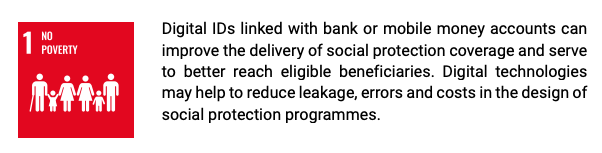
A vital part of the agenda is also digital connectivity and the establishment of a Global Digital Compact. This can be described as a cybernetic organ, consisting of a digitally connected network of people, entities, devices, and things, that easily can be directed by those who run the system. In the Policy Brief it is for example explained how digitisation will help to achieve the global goals. The suggestions happens to be very similar to what World Economic Forum and PwC prescribed in their report Unlocking Technologies for the Global Goals in 2020. A Digital ID is a cornerstone in this work and is among other things seen as a way to reduce poverty.
This may, however, come at a cost. In the UN Secretary-General’s High-level Panel on Digital Cooperations report Age of Digital Interdependence from 2019, it is stated that:
A digital ID can help unlock new opportunities but can also introduce new risks and challenges. They can be used to undermine human rights – for example, by enabling civil society to be targeted, or selected groups to be excluded from social benefits.
Will you get your social protection coverage if you don’t comply with vaccinations or other measures introduced to achieve the SDGs? Probably not. This can later be fused with a social credit system and Central Bank Digital Currency (CBDC) – which is now being introduced and tested in many countries across the world. To receive your daily bread you have to obey and accept the instructions from the Masters that run the show. If the UN declares a “Planetary Emergency” this will have severe consequences for our freedoms (as we experienced during the pandemic).
In the Policy Brief – A Global Digital Compact the authors truthfully are mentioning the rising inequality after the pandemic.
Digital technologies are accelerating the concentration of economic power in an ever smaller group of elites and companies: the combined wealth of technology billionaires, $2.1 trillion in 2022, is greater than the annual gross domestic product of more than half of the Group of 20 economies.
But it seems that United Nations has a somewhat peculiar way of solving this problem. Not only do they strive towards digitising everything – they have also partnered with Big Tech in order to achieve this.
The UN Secretary-General’s High-level Panel on Digital Cooperation was led by Melinda Gates from Bill & Melinda Gates Foundation (according to the bio, Melinda “helped develop many of the company’s multimedia products” during her time at Microsoft) and tech billionaire Jack Ma from the Chinese Ali Baba Group.
This comes with assistance from Young Global Leaders like Mohammed Al Gergawi (chairman of the high-tech Mecca gathering – World Government Summit in Dubai), and Marina Kolesnik (Russia/Ukraine) as well as a “generous” contribution from the World Economic Forums Center for the Fourth Industrial Revolution.
Ali Baba developed Chinas Social Credit System through their subsidiary Ant Group whereas Microsoft promotes Digital ID in the ID2020 Alliance together with GAVI – The Vacccine Alliance and the ever so present Rockefeller Foundation.
United Nations seems to have hired a gang of robbers to manage the bank. These are the “trustees of the material universe for future generations” as stated in the global business elites’ Davos Manifesto from 1973.
Why on Earth would these “enlightened custodians” reverse a development that has put more power and wealth into their hands?
And now our “generous” tech billionaires are heading for Outer Space. The last Policy Brief (The Future of Outer Space Governance) formulates the grand vision to reestablish a presence on the moon with a way station (Lunar Gateway) and the development of a base at the south pole of the Moon as well as conducting a manned mission to the red planet (Elon Musk’s SpaceX).
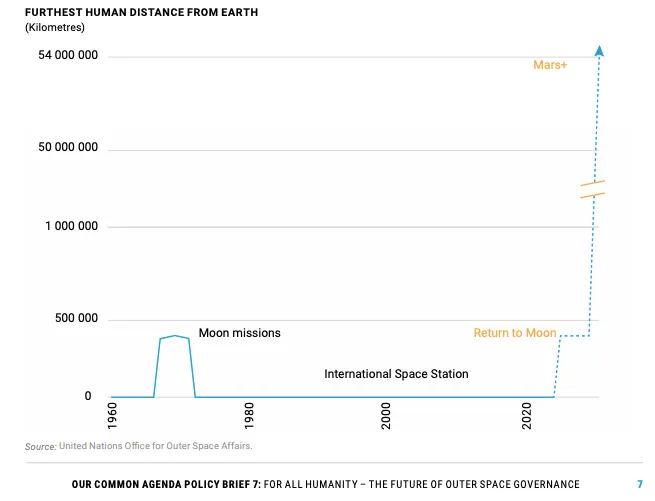
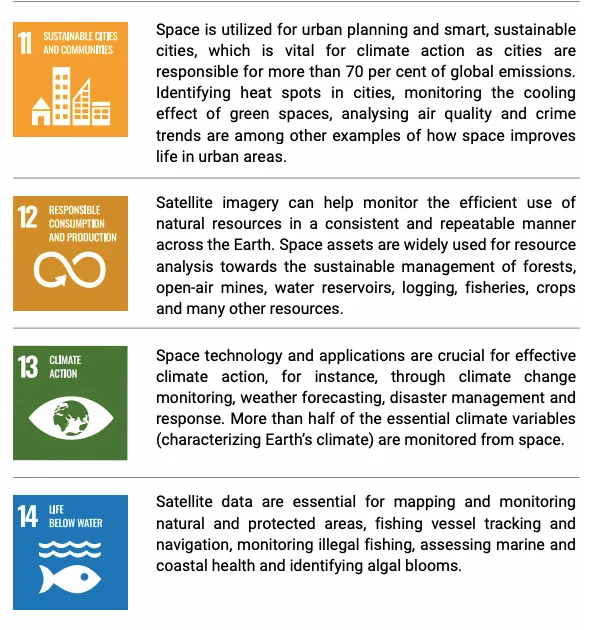
These are old fantasies from the late 1940s that never seem to materialise. But their “space-based opportunities” also highlight the “important link between outer space and the 2030 Agenda for Sustainable Development” with the importance of satellite surveillance to “track deforestation, monitor protected areas for illegal poaching and fishing and assess biodiversity changes” as well as track our every move through the global navigation satellite systems.
As WEF-trustee and Climate Prophet/Profiteer Al Gore proclaimed with a giggle in the commercial for his satellite surveillance project Climate Trace: “And most importantly… NO MORE HIDING”.

Are these people insane? How can the construction of a digital world brain really contribute to a greener and healthier planet?
Wouldn’t it be a more efficient measure to secure peace and the environment on this planet if this megalomaniac elite were sent on a one way mission to Mars?