
This article is a repost with the kind permission from CHD Africa
South Africa is leading African countries in the campaign to reject the WHO facilitated amendments to the International Health Regulations 2005, and to stop the new pandemic treaty, both of which, despite the WHO’s denial, pose clear threats to health, autonomy, and national sovereignty. These controversial instruments also create enormous debt for developing countries.
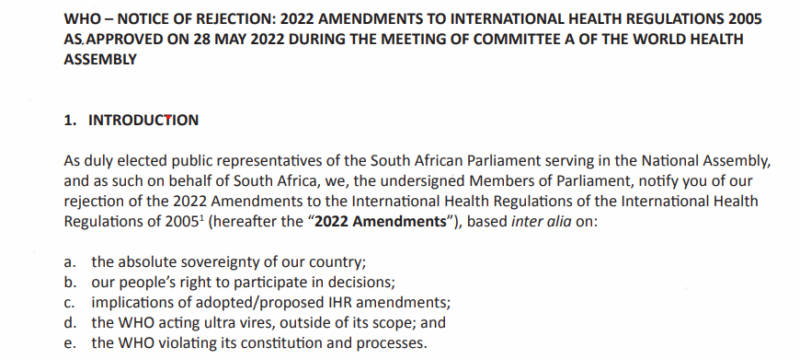
The latest development in the international campaign is a notice letter collaboratively drafted by activist and attorney Shabnam Palesa Mohamed, which was served on the WHO by a member of South Africa’s parliament Steven Swart, together with three other MP’s from the African Christian Democratic Party. The letter rejects duration related amendments to the IHR, that were adopted in 2022.
The concise but detailed notice letter strongly highlights the right to public participation and the role of parliamentary oversight in decision making, enshrined in South Africa’s constitution. It also points to procedural irregularities in WHO processes. The letter gave the WHO 7 days to produce evidence of a lawful voting process on IHR amendments in 2022. The WHO failed to provide evidence.
The letter also highlights a key fact. The IHR appears to not been properly domesticated in South African law:
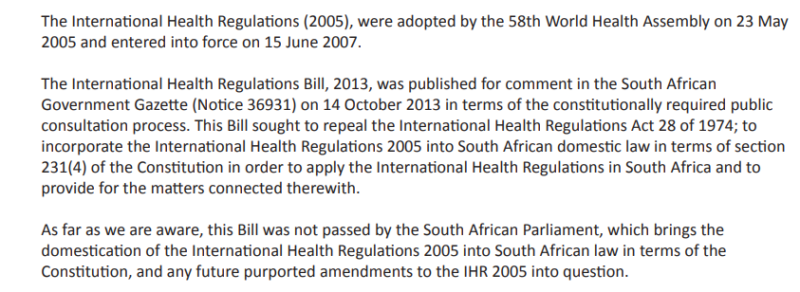
“The International Health Regulations (2005), were adopted by the 58th World Health Assembly on 23 May 2005 and entered into force on 15 June 2007.
The International Health Regulations Bill, 2013, was published for comment in the South African Government Gazette (Notice 36931) on 14 October 2013 in terms of the constitutionally required public consultation process.
This Bill sought to repeal the International Health Regulations Act 28 of 1974; to incorporate the International Health Regulations 2005 into South African domestic law in terms of section 231(4) of the Constitution in order to apply the International Health Regulations in South Africa and to provide for the matters connected therewith.
As far as we are aware, this Bill was not passed by the South African Parliament, which brings the domestication of the International Health Regulations 2005 into South African law in terms of the Constitution, and any future purported amendments to the IHR 2005 into question.”
This means that current amendments and future proposed amendments to the IHR 2005 are null and void in South African law.
Swart later made a submission in parliament during which public participation, parliament’s role, and the IHR amendments were highlighted. He mentioned another MP who is supportive of ivermectin access, National Freedom Party MP Ahmed Munzoor Sheik Emam. Emam had also committed to serving the WHO with a notice of rejection in relation to IHR 2005 amendments made in 2022.
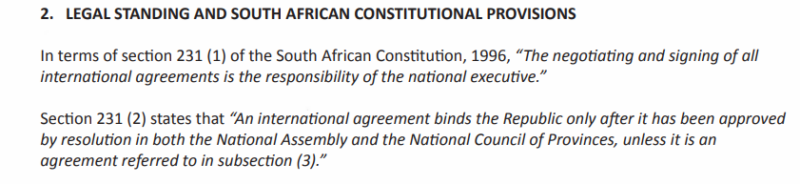
Three other key sections unique to the South African notice letter
Resources:
- Read The Notice Letter: WHO Letter of Rejection_African Christian Democratic Party South Africa
- Watch the Parliament submission at 1m:51s: https://youtu.be/UQL_vR4o5j4?si=TGNP_E3FlrBK-K7Z
Further updates in South Africa’s campaign will follow. Please follow and support CHD Africa