
What is the Latin phrase ad hominem? How is it part of the propaganda toolkit?
Commonly known as “name-calling,” an ad hominem attack “shoots the messenger” in order to deflect from the substance of an issue. It generally means that a criticism of one’s character has been made, rather than a criticism of the issue.
Name calling, or the ad hominem attack, is perhaps the most well-known and easy to identify technique of propaganda in common use.
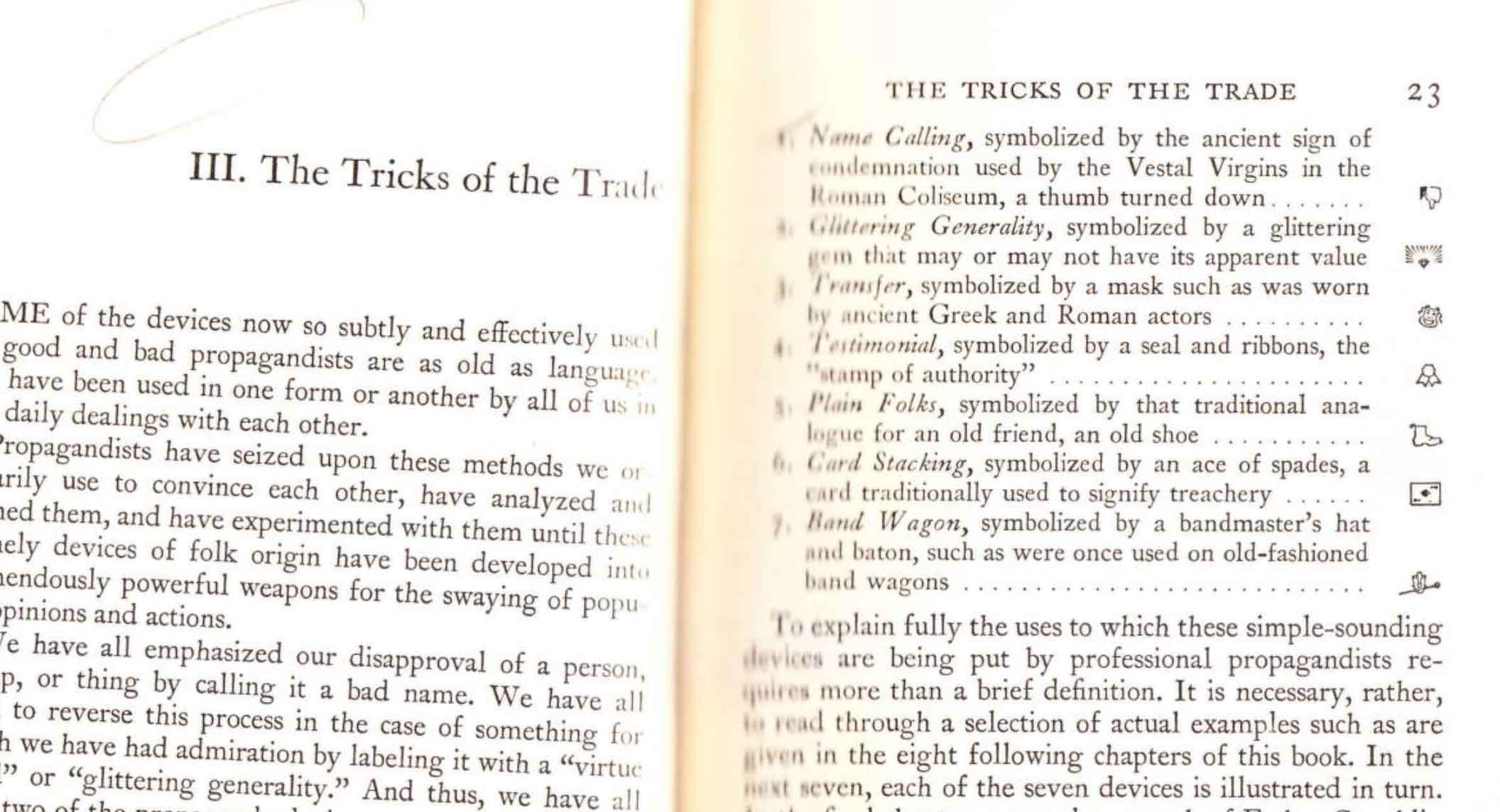
There are Seven Propaganda Techniques, outlined first by the Institute for Propaganda Analysis in the leadup to World War II.
From The Fine Art of Propaganda
The Seven Techniques of Propaganda
- Name Calling – giving an idea a bad label – is used to make us reject and condemn the idea without examining the evidence.
- Glittering Generalities – associating something with a “virtue word” – is used to make us accept and approve the thing without examining the evidence.
- Transfer carries the authority, sanction, and prestige of something respected and revered over to something else in order to make the latter acceptable; or it carries authority, sanction, and disapproval to cause us to reject and disapprove something the propagandist would have us reject and disapprove.
- Testimonial consists in having some respected or hated person say that a given idea or program or product or person is good or bad.
- Plain Folks is the method by which a speaker attempts to convince his audience that he and his ideas are good because they are “of the people,” and the “plain folks.”
- Card Stacking involves the selection and use of facts or falsehoods, illustrations or distractions, and logical or illogical statements in order to give the best or the worst possible case for an idea, program, person, or product.
- Band Wagon has as its theme, “Everybody – at least all of us – is doing it”; with it, the propagandist attempts to convince us that all members of a group to which we belong are accepting his program and that we must therefore follow our crowd and “jump on the band wagon.”[1]
The formal tradition of debating forbids certain types of discourse that, on the surface, appear logical, but are really ways of distracting from a weak position. Among these forbidden techniques – which are really logical fallacies – is the ad hominem attack.[2]
Name-calling, or the ad hominem attack, is used to extreme effectiveness today, at a level perhaps not seen since the McCarthy Era. In the 1940s and 1950s, the “Red Scare” was exemplified by the censorship and persecution of left-wing Americans who might have, in any way, been associated with Communism.
Today, the attack words and name-calling have changed. Accusing someone of being “a communist” will not lead them to any harm. But we all know that publicly stating certain opinions can lead to both character smears and censorship, de-platforming, canceled contracts, firing, and doxxing.
An ad hominem attack does not need to be true for it to be effective. Very few people read beyond a headline. (Congratulations: you are one of those who do!) Very few readers attempt to understand the position of “the other side.” Moreover, unless you are reading from sources outside of the 6 major news conglomerates, you will be reading propaganda.
Children know name-calling is not acceptable, but adults have forgotten this basic principle of social relations. Or they don’t see the ad hominems coming at them. Once you learn to recognize propaganda, you can see things much more clearly, and you will have joined the post-partisan world.
Solutions Toolset: Dealing with a Propaganda-Infused World
- Name it, when you see it, even if just to yourself.
- Live not by Lies by Alexandr Solzhenitsen[3]
- Support and read independent sources outside of the 6 major news conglomerates
- Befriend your neighbor
- Grow food and share it with your neighbor
[1] Lee, Alfred McClung, Elizabeth Briant Lee. The Fine Art of Propaganda: A Study of Father Coughlin’s Speeches. 1939. Harcourt, Brace, and Co. New York. 23-25.
[2] https://thethinkingshop.org/collections/products/products/logical-fallacies-wall-poster
[3] https://journals.sagepub.com/doi/pdf/10.1080/03064220408537357