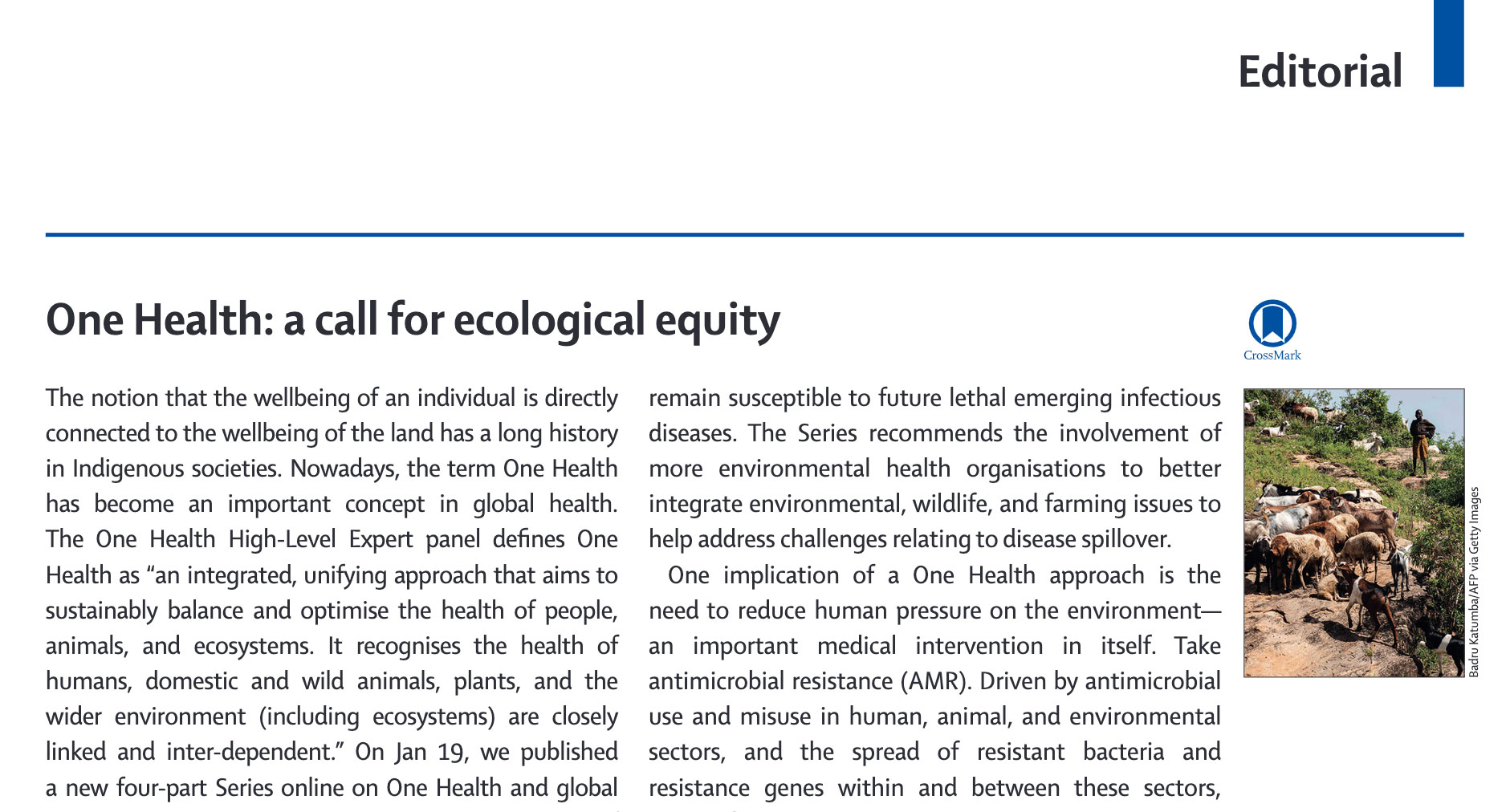

Decoded: One Health wants to lower the status of humans.

Share this article

What did the Lancet say last January about One Health? That non-human animals are of equal concern as humans.

Reposted from Meryl Nass MD Substack.

Link to the original article at the Lancet

“The reality is that One Health will be delivered in countries, not by concordats between multilateral organisations, but by taking a fundamentally different approach to the natural world, one in which we are as concerned about the welfare of non-human animals and the environment as we are about humans. In its truest sense, One Health is a call for ecological, not merely health, equity.”

It is in the last paragraph below. Please reassure yourself that this is really what the WHO, Biden administration, EU, World Bank and all the other One Health scammers are planning for us. Hey, animals need equity too.

Here is what the Treaty says about One Health on page 9. It is a word salad, difficult to decode, but clearly they are very serious about this ONE HEALTH thing, devoting an entire Article (of 36 articles total) to it. Bsically they do not want us to know what it means.

Similar Posts

  • What is “nullification”?

    Share this article

    Share this article A win for states’ rights: how do state sovereignty laws apply to the WHO and…

  • Why Can States Assert that the WHO Has No Authority Over Them?

    Share this article

    The Tenth Amendment of the US Constitution’s Bill of Rights states, “The powers not delegated to the United States by the Constitution, nor prohibited by it to the States, are reserved to the States respectively, or to the people.” This means that the regulation of healthcare falls to the states.

  • The “One Health” Agenda

    Share this article

    In today’s installment, we will examine the One Health agenda and how it threatens to destroy both food freedom and medical freedom. 
    The term “One Health” was coined after the first SARS outbreak in the early 2000s to reflect the danger of new diseases emerging from human-animal contact. It refers to the idea of public health being not just about your health but also about animal and “planetary” health. It is framed in language designed to sound appealing and holistic.

  • No, solar panels are not farmland

    Share this article

    Concerned that rapid development threatened critical agricultural resources, Indiana’s Legislature in 2023 commissioned a study to determine the status of the state’s farmland. Noting that most agricultural land loss neighbored cities and suburban areas, the study concluded that Indiana lost 345,682 acres of farmland between 2010 and 2022.