
| |

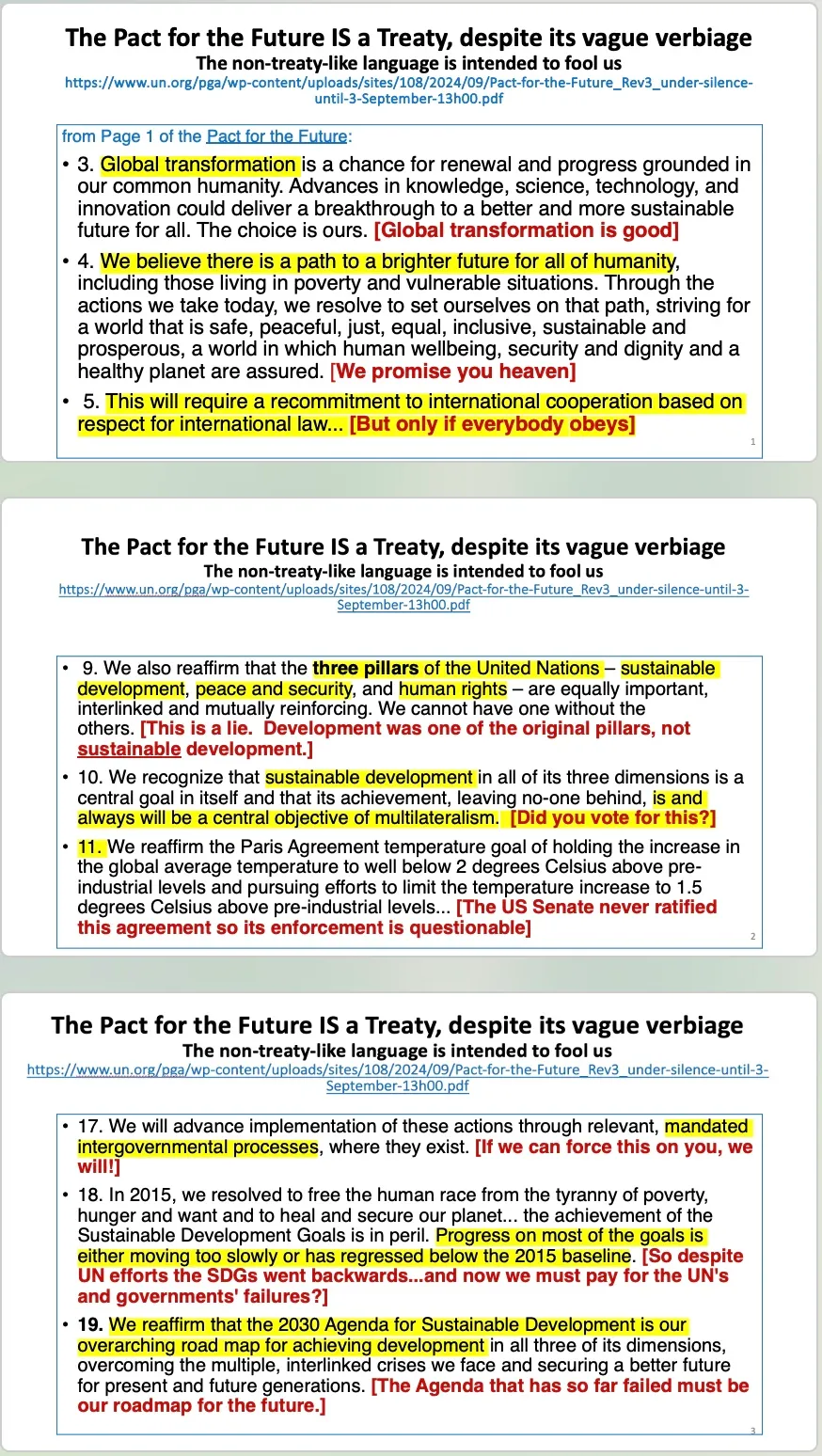
37 statements from the Pact for the Future with my deconstruction, in 13 slides

Share this article

What are the simple take-home messages regarding the Pact for the Future?

  1. It is highly repetitive
  2. It is replete with aspirational language about how, by following the Agenda for the SDGs or using other unspecified methods, the world’s problems will be solved. No details, of course. No examples.
  3. However, the Pact acknowledges that essentially no progress has been made on the SDGs since they were established in 2015.
  4. But what that means is we have to turbocharge our efforts to accomplish them all by 2030, for some obscure reason. [BTW, the planet is claimed to have reached 2.06 degrees C above the limit — briefly — and nothing happened.] [BTW, according to this site https://climate.copernicus.eu/sea-ice-cover-august-2024
    • Arctic sea ice extent was 17% below average
    • Antarctic sea ice extent was 7% below average, the second-lowest extent for August in the satellite data record—and yet we have not heard of a single city or town under water, and Plymouth Rock is right at the water level it was in 1612.
  5. The Pact’s language is so poorly crafted in some places that the meaning cannot be understood.
  6. It seeks to have nations obey commitments apparently made in many earlier documents, but never states exactly what those commitments are.
  7. It therefore seems to be simply one more puzzle piece in a complex and massive set of international agreements that were crafted to include specific passages that together will transform the way the world is governed.

I selected 37 examples from the Pact to show what the UN is really about, because I have not seen that anyone else has done this. I will repeat the earlier slides because I messed up that post, omitting a slide and showing one twice.

Loader Loading…
EAD Logo Taking too long?

Reload Reload document
| Open Open in new tab

Pact For The Future Decoded In 13 Slides

Similar Posts

  • Propaganda Toolkit #1: Ad Hominem Attacks

    Share this article

    Commonly known as “name-calling,” an ad hominem attack “shoots the messenger” in order to deflect from the substance of an issue. It generally means that a criticism of one’s character has been made, rather than a criticism of the issue. Name calling, or the ad hominem attack, is perhaps the most well-known and easy to identify…

  • Bret Weinstein discusses the WHO Risks

    Share this article

    Bret Weinstein is an evolutionary biologist, bestselling author and co-host of the Darkhorse podcast with his wife, co-author and evolutionary biologist, Heather Heying.

  • What is ESG?

    Share this article

    ESG stands for Environmental, Social, and Governance and is a set of standards put forth by the WEF to challenge corporations to rate themselves on their social responsibility, and to offer investors a way to choose their investments by evaluating corporations using these standards. The standards encompass:
    – The “E” captures energy efficiencies…

  • CBDCs: Ultimate Tool of Oppression

    Share this article

    If you want a picture of the future, imagine a boot stamping on a human face – for ever,’ said O’Brien, the grand inquisitor of the totalitarian regime in Orwell’s futuristic novel 1984.
    Alternatively, you could imagine a sandal. Last month I visited Sutton Hoo, the famous Anglo-Saxon burial site of a king and his ship in Suffolk…

  • Food Corruption: Fake Meat, GMOs, and Beyond

    Share this article

    Most readers are likely familiar with GMOs and how genetically modified organisms have been shown to cause significant health problems, how they have ruined the lives of independent farmers who are sued after their land is involuntarily contaminated by Monsanto seeds, and how glyphosate use has risen thanks to Roundup Ready GMO crops. Unfortunately, corruption of the food supply is advancing far beyond this.