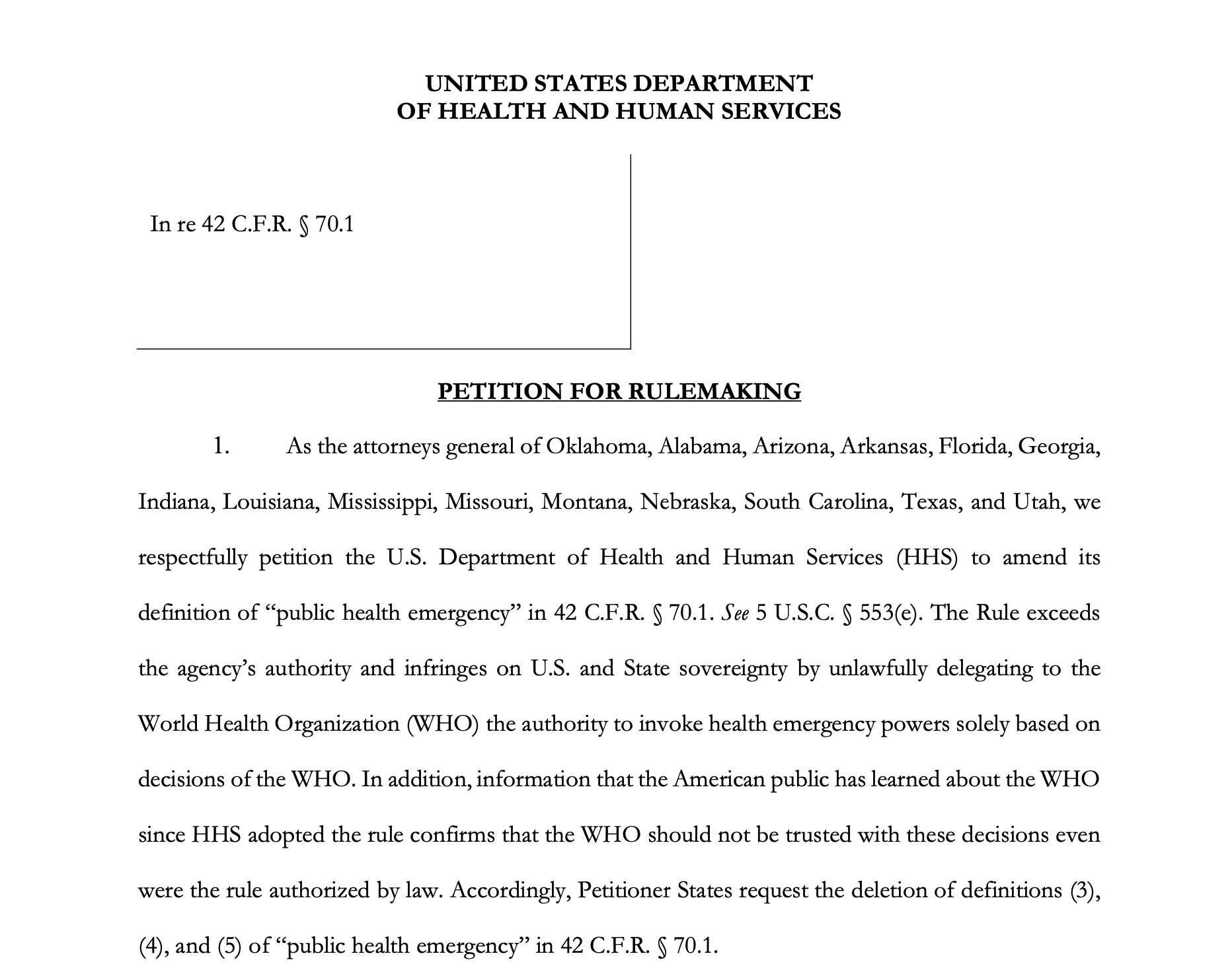

The Petition for Rulemaking was denied by HHS.
Dated July 18, 2022, fifteen state Attorneys Generals added their names to a Petition to Department Health and Human Services (HHS) for Rulemaking. This petition sought the following results:
- That HHS amend its definition of public health emergency
- That the amended definition not rely upon determinations or information from the WHO.
The arguments put forth by the 15 AGs are direct, forceful, and aimed to protect state police powers. What happened?
Quoting from the document:
Microsoft Word – WHO Petition (FINAL)
All federal agencies, including HHS, are forbidden from delegating their decisions to foreign nations or international organizations absent express provision by Congress. Here, there is no treaty or international agreement that calls for or requires delegation like this. Even if there were such a treaty, Congress would need to implement such a treaty. Because Congress has not authorized delegating declarations of public health emergencies to the WHO, HHS has exceeded its authority by promulgating rules that make just such a delegation.
page 4
The WHO Constitution was never ratified as a treaty by two-thirds of the Senate. Instead, Congress passed a joint resolution authorizing the President to participate in the WHO. See Pub. L. No. 80-643, 62 Stat. 441 (June 14, 1948).2 Accordingly, the WHO Constitution is not a binding treaty but is instead an executive agreement that only has such effect on domestic legislation as Congress has expressly prescribed.
Congress has forbidden domestic effects of the WHO Constitution. When authorizing participating in the WHO, Congress stated that it approved participation “with the understanding that nothing in the Constitution of the World Health Organization in any manner commits the United States to enact any specific legislative program regarding any matters referred to in said Constitution.” 22 U.S.C. § 290d.
page 5
While delegation to any outside group (including the WHO) is unlawful, delegating decisions to an international organization causes particular harm to the sovereignty of both the United States and the Petitioners.
No federal power over international relations allows the federal government to delegate police powers to an international organization.
page 7
By permitting the WHO to determine when a public health emergency exists, HHS is attempting to use its interstate commerce authority to transfer police power to an international organization, assigning the sovereign police power outside the constitutional order. This delegation of authority not only violates nondelegation principles but also infringes State sovereignty, as States would otherwise retain a wide range of police powers to address public health emergencies subject only to congressional action.
page 8