
- The Tenth Amendment of the US Constitution’s Bill of Rights states, “The powers not delegated to the United States by the Constitution, nor prohibited by it to the States, are reserved to the States respectively, or to the people.” This means that the regulation of healthcare falls to the states. For example, doctors, pharmacies and hospitals are administered by the state, not by the federal government.
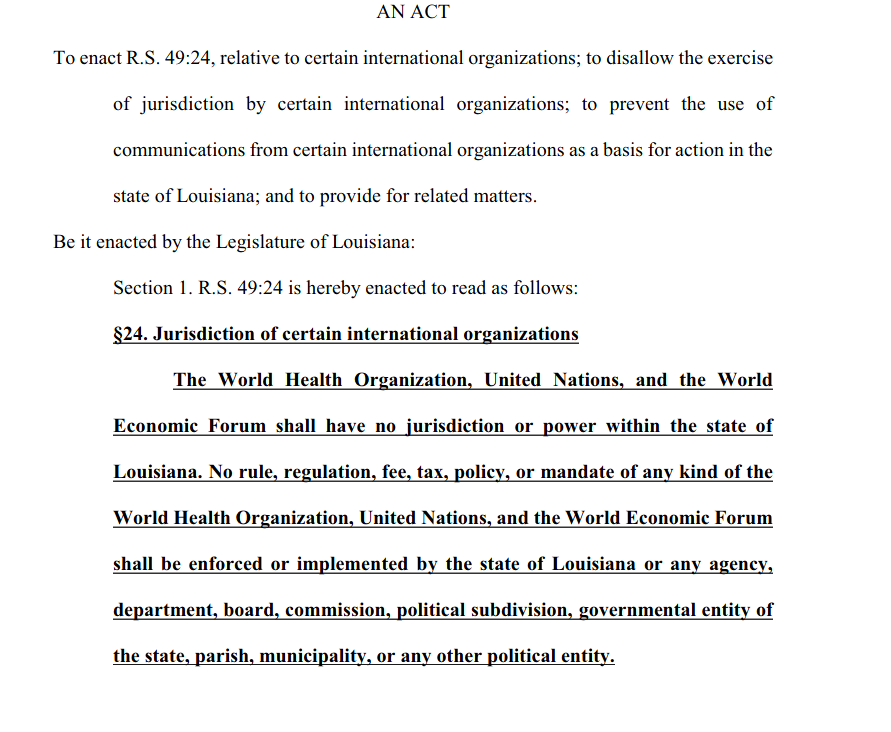
- This is why Louisiana’s Senate unanimously passed a bill 37 to zero telling the world that neither the WHO, the UN nor the WEF could assert any jurisdiction over health or any other matter in the state of Louisiana.
- This is why the Florida legislature passed a bill last year allowing the WHO no authority over the state of Florida.
- On the last full day of the Obama administration, the Department of Health and Human Services’ Centers for Disease Control issued a Final Rule that changed the definition of a Public Health Emergency of international Concern. It was to be defined 5 ways, but 3 of those ways relied on a WHO decision.
- This rule was challenged in a petition to DHHS by 15 state Attorneys General in 2023. They pointed out that, “The rule exceeds the agency’s authority and infringes on US and state sovereignty by unlawfully delegating to the World Health Organization the authority to invoke health emergency powers solely based on decisions of the WHO.”
- The AGs further noted that Congress’ assent would be needed to delegate such authority via treaty ratification to the WHO. They assert that executive agreements, which “rely solely on the President’s authority in foreign relations… lack any domestic effect without an act of Congress,” and that the unratified WHO Constitution is not a binding treaty.
- Furthermore, according to the AGs, Congress approved participation with the WHO “with the understanding that nothing in the Constitution of the World Health Organization in any manner commits the United States to enact any specific legislative program regarding any matters referred to in said constitution,” referencing 22 U.S.C. 290d, while noting that 42 U.S.C. 264 (e) warns the federal government not to preempt state powers regarding control of infectious diseases.
- Finally, when the US federal government signed the WHO’s amended International Health Regulations in 2006, it filed a reservation acknowledging the states’ rights authority over some health matters. The reservation said, in part, “… these regulations to be implemented by the Federal Government or the state governments, as appropriate and in accordance with our Constitution, to the extent that the implementation of these obligations comes under the legal jurisdiction of the Federal Government. To the extent that such obligations come under the legal jurisdiction of the state governments, the Federal Government shall bring such obligations with a favorable recommendation to the notice of the appropriate state authorities.“
Therefore, there is a strong legal basis to assert that the states not only have authority over their citizens’ healthcare regulation, but that the federal government lacks the authority to delegate any such power to the WHO.
Meryl Nass, MD
March 31, 2024